What You'll Learn from This Article
- An e-commerce website is a brand-owned, independent sales channel where products and services are sold online as a web platform.
- An e-commerce website is made up of core components that work together such as the catalog, cart, virtual POS, membership and admin panel.
- Unlike a marketplace, an e-commerce website keeps control, design and customer data entirely with the business and pays no commission.
- A ready-made platform offers a fast start, while custom software gives a healthier long-term foundation for growing, distinct needs.
- SSL and KVKK compliance are indispensable requirements for an e-commerce website in 2026 for both trust and legal compliance.
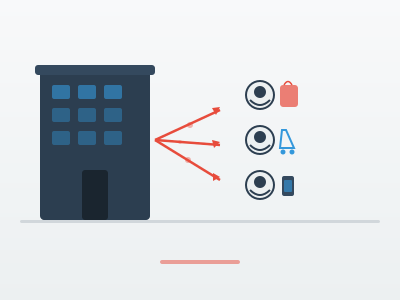
Quick answer: An e-commerce website is a web platform where products or services are sold online, built from core components that work together. A product catalog, cart, payment infrastructure through a virtual POS, membership and an admin panel come together to make it function. Unlike a marketplace, an e-commerce website operates as a fully brand-owned, independent sales channel, and the customer relationship along with all data stays entirely with the business.
What an e-commerce website is and why it matters in 2026
An e-commerce website is a digital store where a business displays and sells its products or services under its own domain, where visitors add items to a cart and complete an order through secure payment. In 2026, the majority of consumers begin the buying journey on a mobile device, so the technical foundation of the site directly determines sales success. The table below summarizes the core components that form the foundation of every e-commerce website along with their functions.
| Component | Function | Importance | Note |
|---|---|---|---|
| Product catalog and categories | Lists products in an organized structure | High | A correct category tree increases discoverability |
| Cart and checkout | Collects selected items and prepares the sale | Critical | A fast flow lowers the abandonment rate |
| Payment infrastructure (virtual POS) | Provides secure collection by card | Critical | 3D Secure and bank integration are mandatory |
| Membership and account | Holds customer data and order history | High | It is the basis of repeat sales |
| Search and filtering | Enables fast access to the right product | High | Raises conversion in large catalogs |
| Admin panel | Offers product, order and content management | High | It is the daily center of operations |
| Shipping and delivery integration | Connects the dispatch and tracking process | Medium | Automatic shipping labels speed the process |
| Security and SSL | Encrypts data and payment traffic | Critical | Mandatory for trust and compliance |
The 12 core components and features of an e-commerce website
Assuming an e-commerce website is nothing more than a single page would be misleading. In reality it is the harmony of dozens of modules talking to one another. Below we define, one by one, the twelve core components and features that form a solid e-commerce website.
1. Product catalog and categories
The catalog is the structured record of every product on sale. Thanks to categories, subcategories and tags, the visitor finds what is sought within a logical hierarchy. A well designed catalog strengthens both the user experience and search engine visibility.
2. Product detail page
The product detail page is the actual screen where the purchase decision is made. Images, description, price, stock status, variations and reviews all come together here. A clear and reassuring detail page is one of the strongest determinants of the conversion rate.
3. Cart and quick checkout
The cart is the intermediate stage that holds selected items and calculates the total amount. Quick checkout then converts this cart into an order with the fewest possible clicks. A flow stripped of unnecessary fields noticeably reduces the cart abandonment rate.
4. Payment infrastructure (virtual POS)
The virtual POS is the infrastructure where card details are transmitted securely to the bank and collection takes place. 3D Secure verification, installment options and support for multiple banks are managed in this layer. Without a solid payment integration, an e-commerce website cannot truly make sales.
5. Membership and account management
The membership module stores the address details, order history and preferences of the customer. Through account management, repeat shopping is completed far more quickly. This layer is also the foundation of loyalty and personalization efforts.
6. Search and filtering
The search box and filters bring the visitor to the right product within seconds in large catalogs. Filters such as price range, brand, color and size make the decision easier. Smart search tolerates spelling mistakes and recovers sales that would otherwise be lost.
7. Admin (management) panel
The admin panel is the control center where the business runs its daily operations. Adding products, updating prices, tracking orders and editing content are all done here. An intuitive panel lets the team move quickly without requiring technical knowledge.
8. Shipping and delivery integration
Shipping integration enables the order to be transferred to the carrier and the tracking number to be generated automatically. The customer can follow the shipment, while the business manages labels and processes from a single screen. This automation reduces both the margin of error and the labor load.
9. Security and SSL
An SSL certificate protects data by encrypting traffic between the visitor and the server. The security layer also guards against malicious requests and data leakage. In 2026, SSL is no longer a choice but a mandatory requirement for both trust and compliance.
10. SEO and performance
A search engine friendly structure allows the site to reach new customers through organic traffic. Fast loading pages positively affect both user satisfaction and ranking. A clean address structure, title tags and structured data form the core of this layer.
11. Mobile compatibility
Because the majority of traffic comes from mobile devices, the site must work flawlessly on small screens. Responsive design, touch friendly buttons and a fast mobile payment flow are critical. A visitor struggling on mobile abandons the site before switching to a desktop.
12. Reporting and analytics
Reporting shows which product sells, where traffic comes from and where conversion breaks down. Without this data, improvement relies on guesswork and slows down. A good analytics setup places decisions on a measurable and repeatable foundation.
Types of e-commerce websites
Although all e-commerce websites serve the same purpose, they differ according to the target audience and the sales structure. The types below describe the most common structures. The subject of business models and operational setup is handled in a separate article.
B2C e-commerce site
A B2C site is the structure where the business sells directly to the end consumer. The storefront, product detail and quick checkout flow are designed around individual shopping. It is the form most often preferred by retail focused brands.
B2B e-commerce site
A B2B site focuses on business to business wholesale selling. Features such as dealer pricing, current account, quantity based discounts and quotation management stand out. It generally uses a closed structure based on membership.
Marketplace (multi-vendor)
A marketplace is the structure where multiple sellers offer products through the same platform. The platform owner operates the infrastructure, while sellers manage their own products. Commission and seller management sit at the center of this model.
Single-vendor site
A single-vendor site is an independent store where only one brand sells its own products. Brand control, design freedom and customer ownership are at the highest level. The core e-commerce website defined by this guide is largely this model.
Hybrid and niche sites
Hybrid sites combine retail and wholesale under one roof and address both individual and corporate customers. Niche sites, on the other hand, focus on a specific category or target audience to offer depth. These structures suit brands with customized requirements.
Ways to build an e-commerce website
There are several technical approaches to bringing an e-commerce website to life. The right choice depends on budget, the need for control and the growth goal. The options below summarize the main build paths conceptually.
- Ready-made platform: Services such as Shopify or WooCommerce offer a fast start and low technical burden; they work on a subscription basis and customization is limited.
- Open-source self-hosted: The code belongs to you and you manage the hosting; this provides more flexibility, but the responsibility for technical maintenance passes to the business.
- Fully custom software: The site is developed from scratch according to the requirements of the brand; it offers full control, unlimited customization and unique workflows.
- Decision criteria: The balance of cost, control and scalability determines the choice; as the long-term goal grows, the return on a custom solution increases.
No single approach is the one right answer for every business. While a ready-made platform makes sense for small and standard needs, custom software is healthier in the long run for brands with distinct business rules and a high growth goal.
E-commerce website versus a marketplace
The fundamental distinction between an e-commerce website and a marketplace lies in ownership; an e-commerce website belongs entirely to the brand, so brand control, design and customer data remain with the business and no commission is paid, but in return the business has to bring its own traffic, whereas a marketplace offers a ready audience and high visibility yet takes a commission on every sale and largely keeps the customer relationship and the data in the hands of the platform, which is why a marketplace is suitable for fast reach and testing, while for long-term brand value, data ownership and sustainable profitability the businesss own e-commerce website is the most correct foundation.
Why Demircode
Demircode is a software company that has been operating since 2011 and has delivered more than a hundred projects exceeding 100 thousand lines of code. We do not build with ready-made templates; we develop fully custom B2C and B2B e-commerce websites according to the unique business rules of each brand. Below are the reasons that make us the right choice.
- Fully custom e-commerce website: We build a structure designed from scratch for the needs of your brand, without being bound by template limits.
- Secure payment integration: With the DPay infrastructure, we provide virtual POS and bank integrations securely and seamlessly.
- B2B and B2C ready: We support both individual and corporate sales scenarios within a single architecture.
- SEO and AI friendly structure: We establish a clean technical foundation that is easily read by search engines and the new generation of AI assistants.
- Scalable architecture: We design an infrastructure that grows smoothly together with rising traffic and catalog size.
- Long-term technical partnership: We offer a collaboration that does not end at delivery but stays by your side throughout updates and development.
To build a sales channel specific to your brand, you can review our B2C E-Commerce Web Solutions and, for wholesale, our B2B E-Commerce Web Solutions, set up secure collection on the payment side with DPay Payment Integration, look at our How to Build an E-Commerce Website article for the setup steps, and for an overview of the whole business check our How to Start an E-Commerce Business guide.
FAQ
What is an e-commerce website
An e-commerce website is a digital store where a business sells its products or services online under its own domain, made up of a product catalog, cart, payment infrastructure and admin panel. It works as a brand-owned, independent sales channel.
What are the core parts of an e-commerce site
The core parts are the product catalog and categories, the product detail page, the cart and checkout step, the virtual POS, membership, search and filtering, the admin panel, shipping integration and the security layer. These components work together to complete the sales flow.
What is the difference between an e-commerce site and a marketplace
An e-commerce site belongs entirely to the brand; control, design and customer data stay with the business and no commission is paid. A marketplace offers a ready audience but takes a commission on every sale and largely keeps the customer relationship in its own hands.
Is a ready-made platform or custom software better
This choice depends on the need. For standard and small scale operations a ready-made platform is fast and economical; for brands that require distinct business rules, high growth and full control, custom software provides a healthier foundation in the long run.
Does an e-commerce site need SSL and KVKK compliance
Yes, it is required. An SSL certificate protects payment and user data through encryption, while KVKK compliance makes the lawful collection and storage of personal data mandatory. Both are indispensable for trust and legal compliance alike.
Conclusion
In short, an e-commerce website is a fully brand-owned, independent online sales channel where core components such as the product catalog, cart, virtual POS, membership and admin panel work in harmony, and unlike a marketplace it leaves control, data and the customer relationship with the business; to build a solid foundation specific to your brand, you can begin with our B2C E-Commerce Web Solutions service.
Related Products


Related Services