Who Is This For?
Highlights
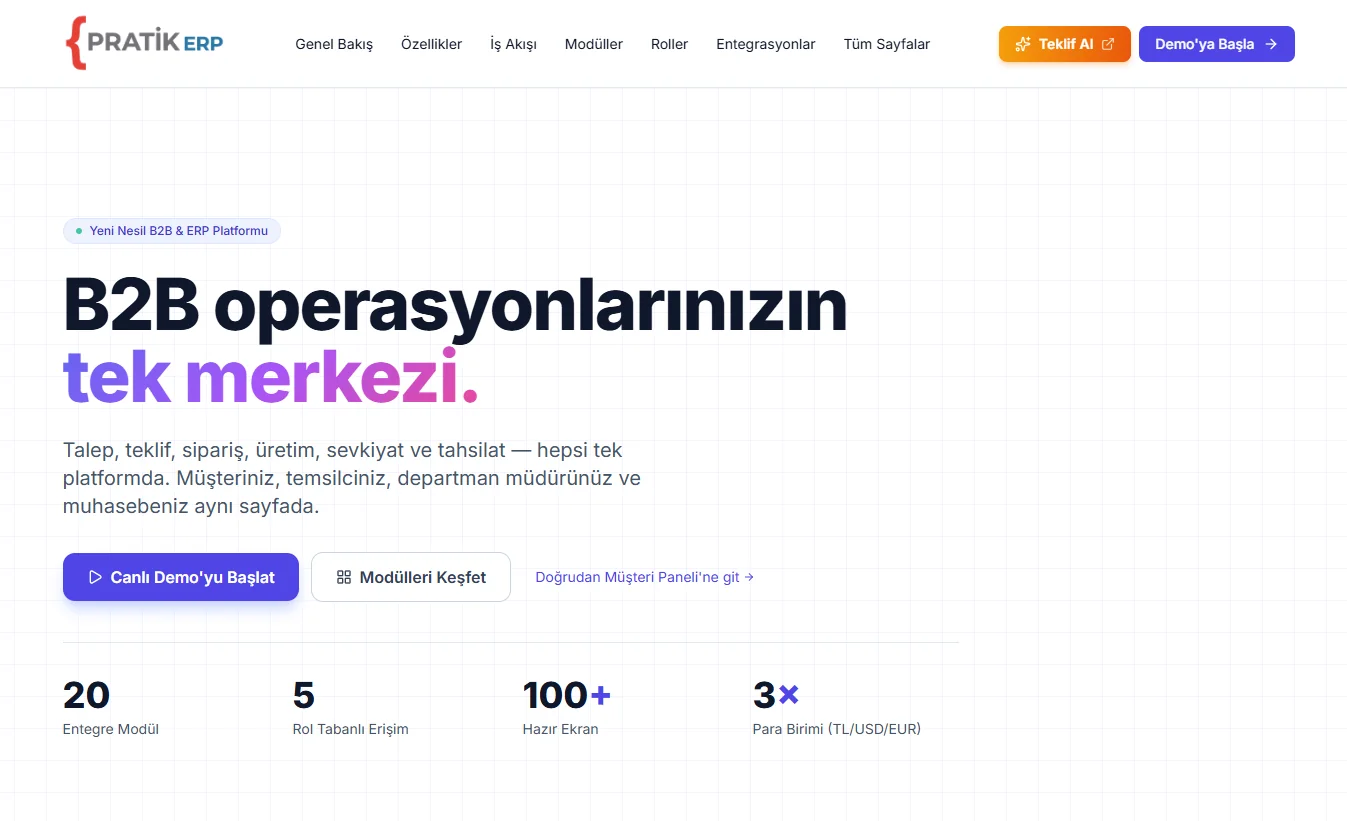
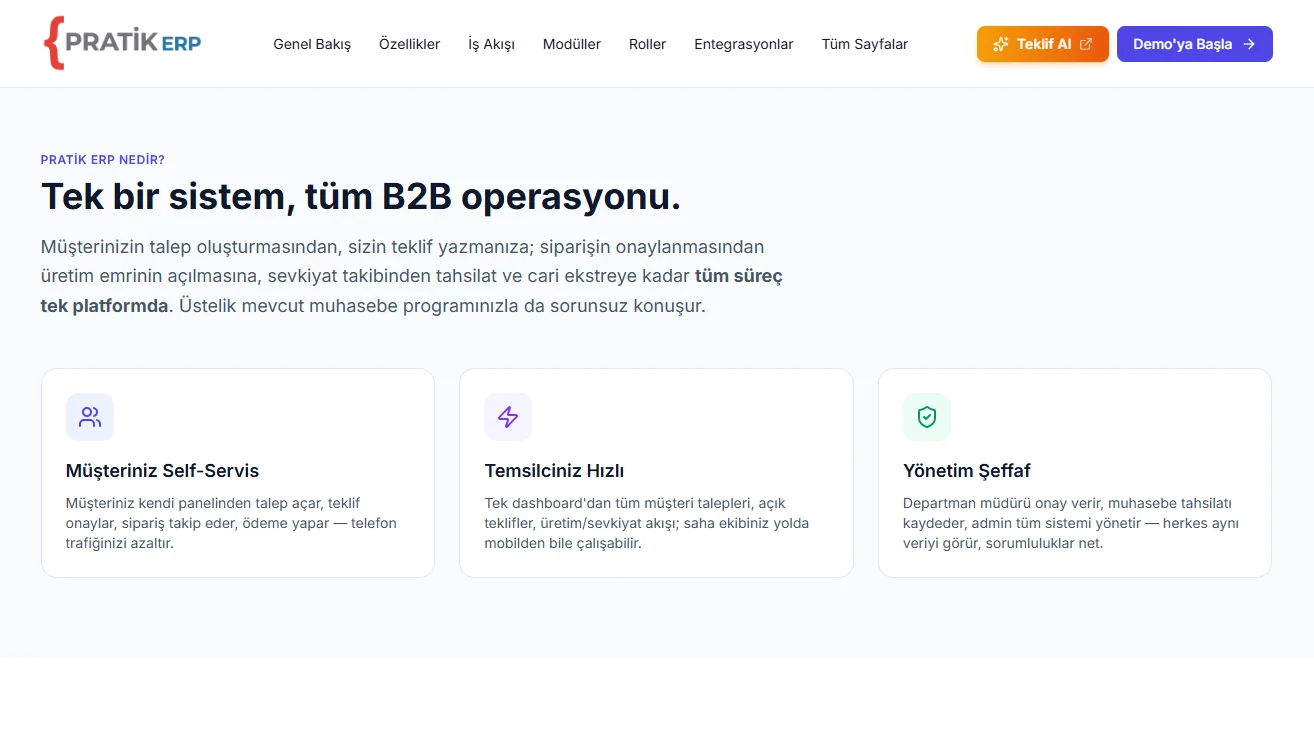
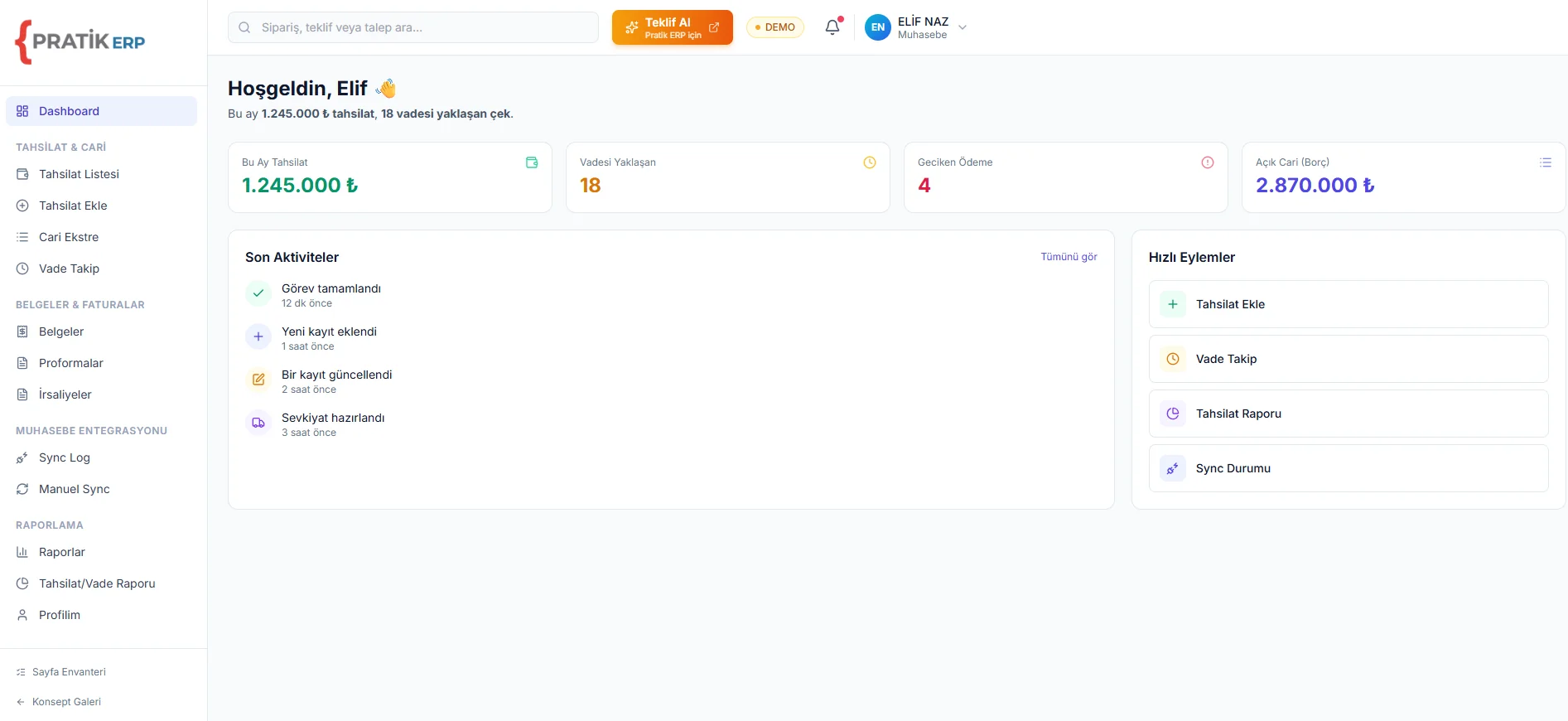
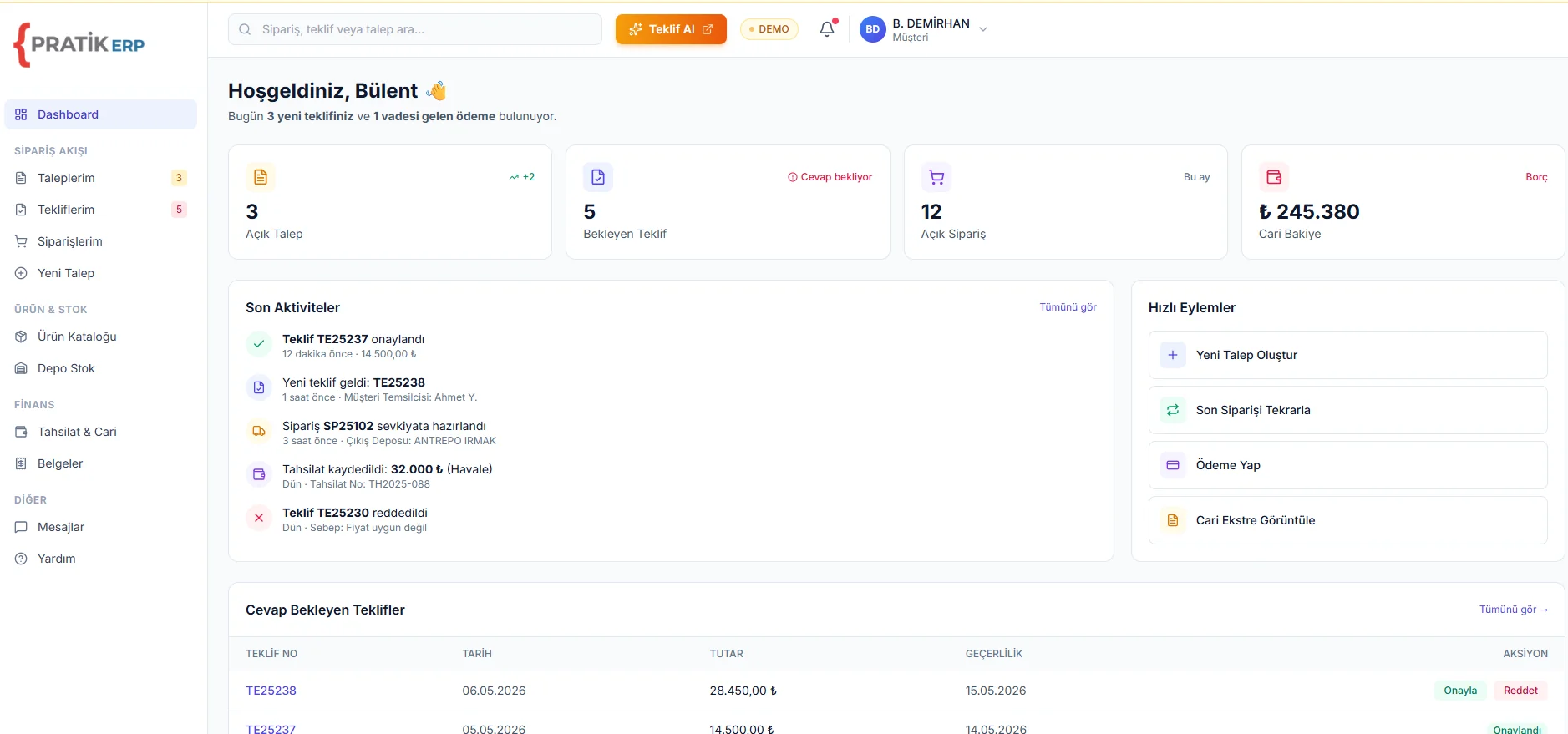
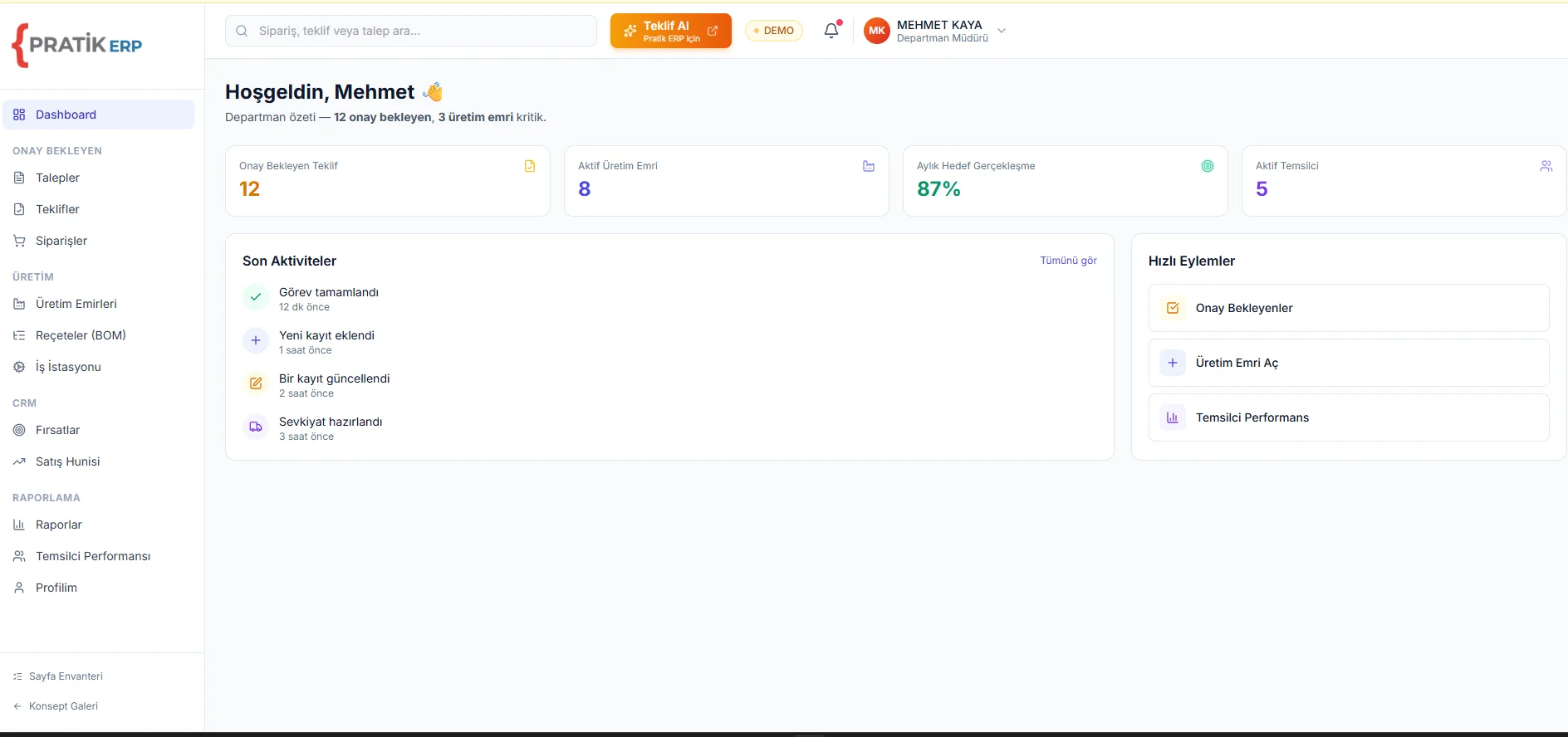
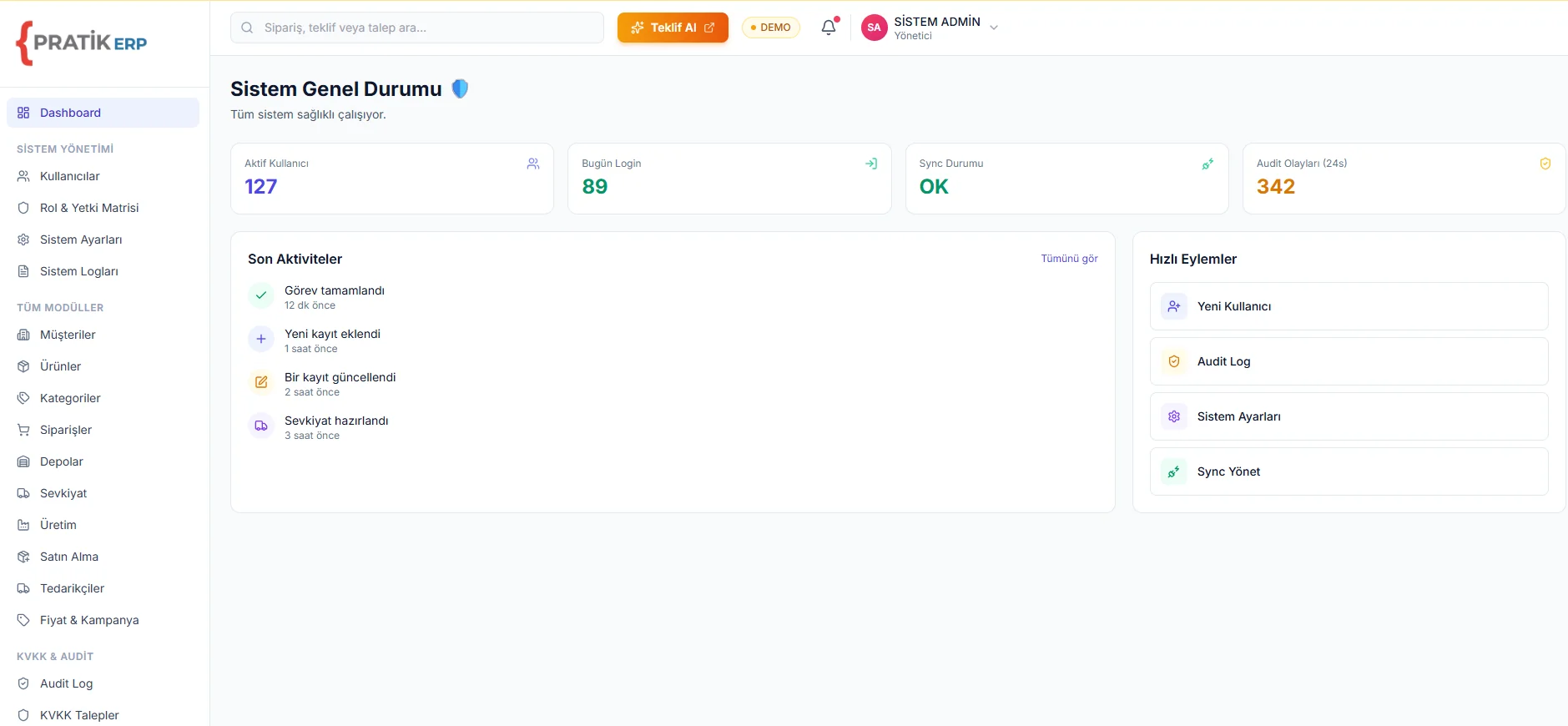
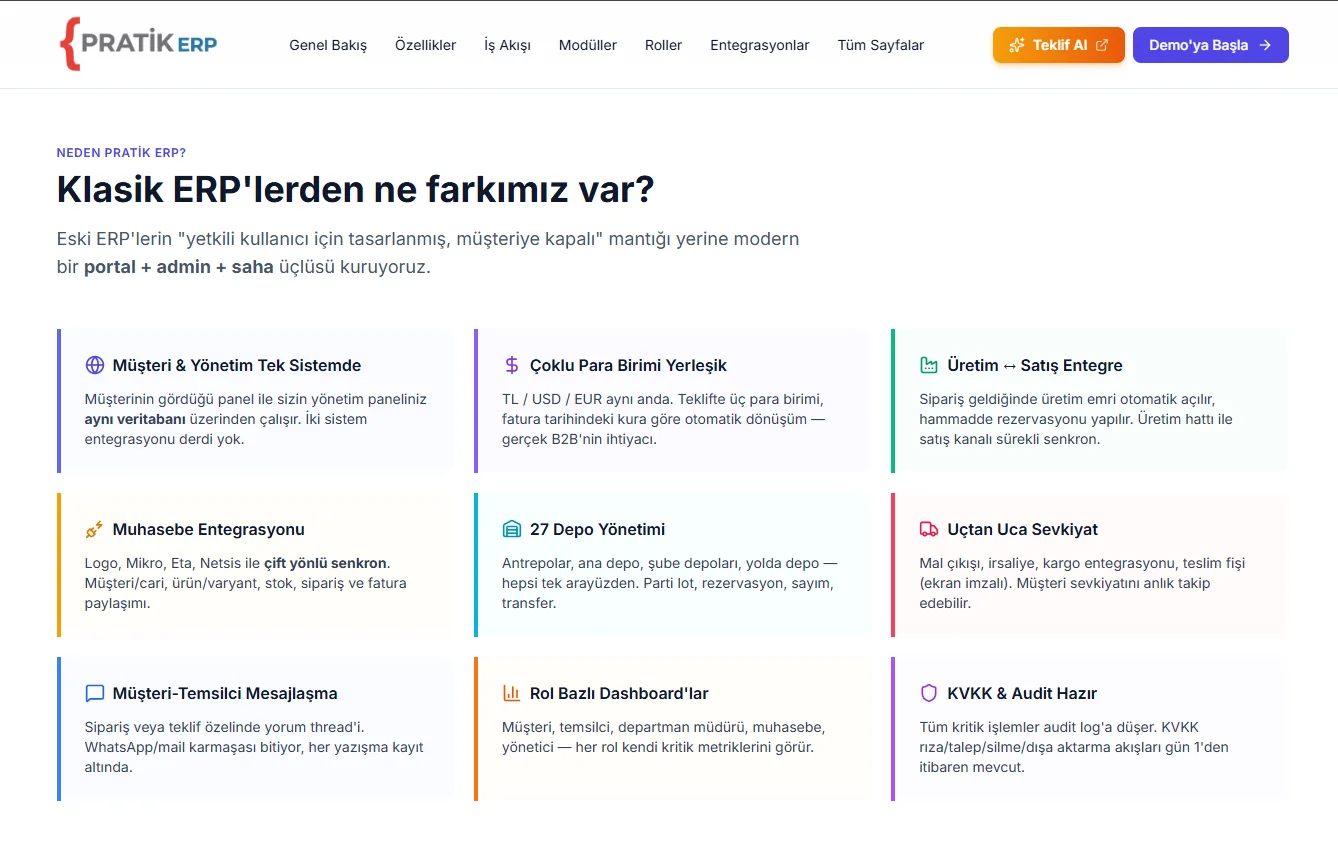
Pratik ERP is a modern ERP and CRM platform designed to meet the integrated operations management needs of growing SMEs and mid-market companies. Instead of the heavy interface and lengthy deployment cycles of traditional enterprise ERP software, it delivers a clean, modular, cloud-based solution that lets a business orchestrate every process — from customer relationships to procurement, from production planning to financial collections — through a single panel.
Modular Architecture, SME-Friendly Onboarding
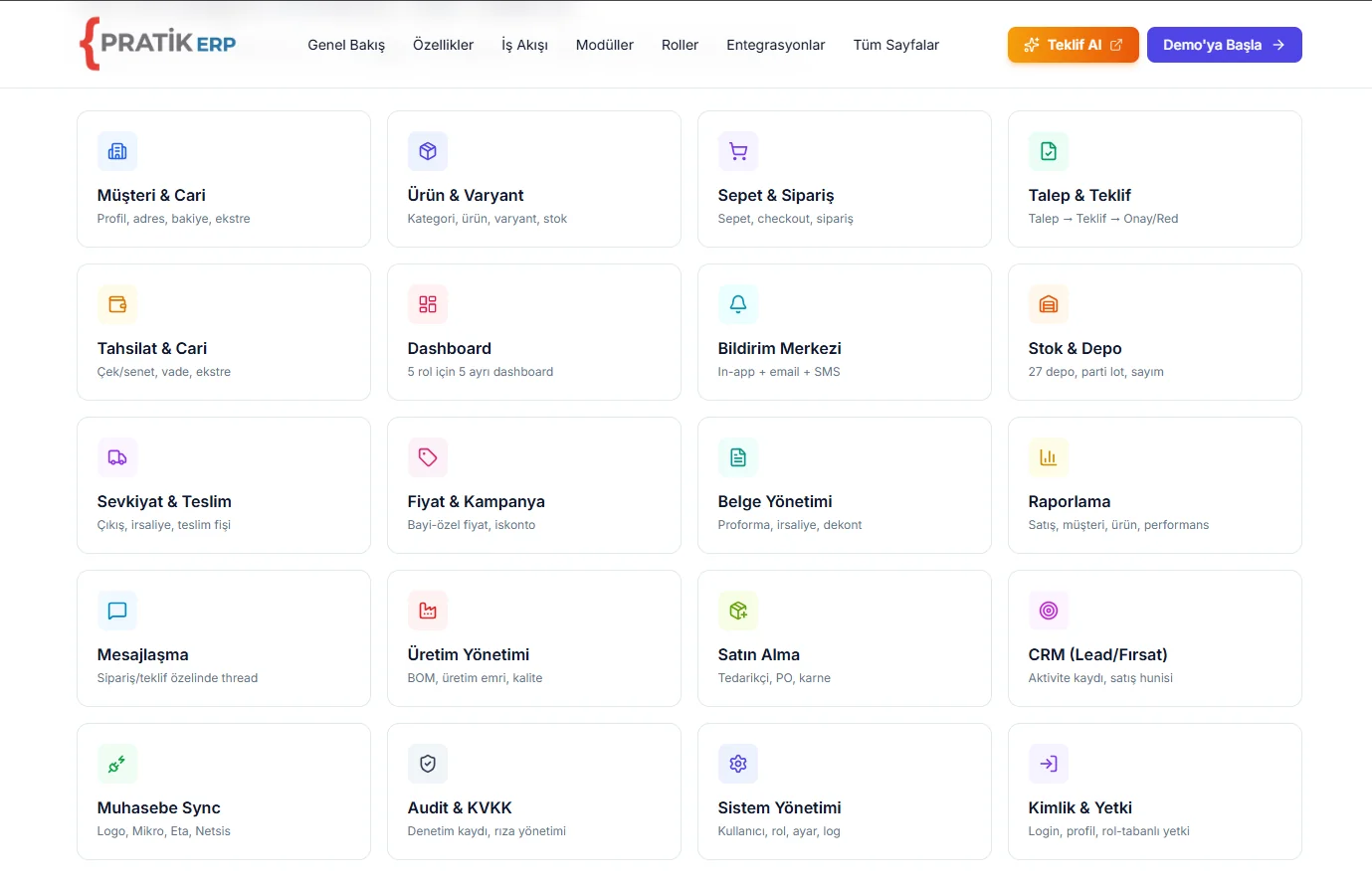
Pratik ERP follows a 'buy what you need, expand as you grow' philosophy. You start with four core modules — CRM, sales-marketing automation, inventory-warehouse, and finance-collections — and add production, B2B dealer portal, AI-driven sales forecasting, mobile app, SAP/Mikro/Logo accounting integration, or SMS/email automation as your business scales. This approach keeps the initial investment low and prevents paying for modules the company does not actually use.
From Customer Relationships to Supply Chain on a Single Platform
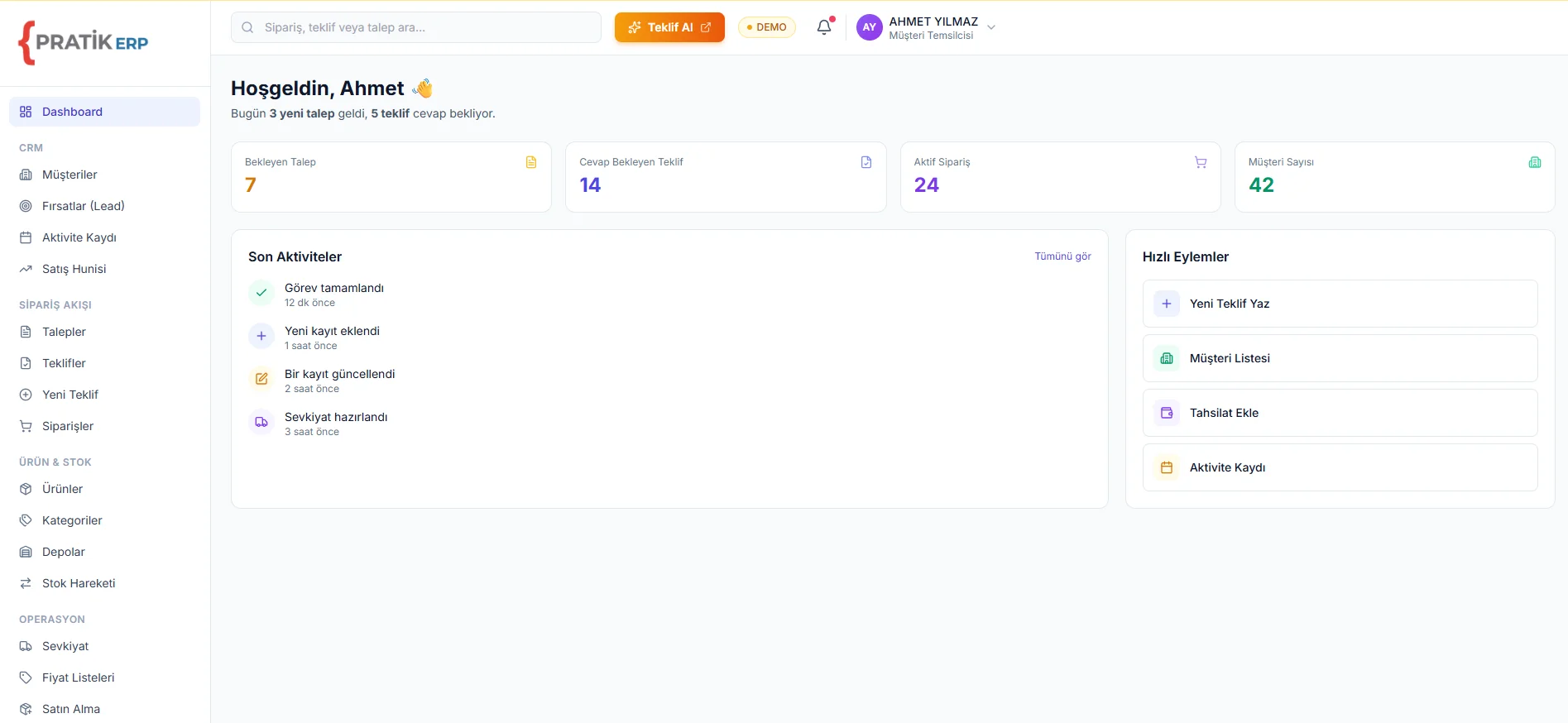
The CRM module brings every customer touchpoint — communication history, order records, invoiced amounts, payment plans, support tickets — into a unified 360° customer view; the sales team tracks all interactions across email, phone, WhatsApp, and social channels from one place. The procurement module offers supplier performance tracking, automated approval flows, RFQ (request-for-quotation) management, and investment cost calculation. The inventory module digitizes end-to-end stock operations with barcode integration, multi-warehouse support, low-stock alerts, and shipment tracking.
Manufacturing, B2B and Smart Collections
The production planning module increases operational efficiency for manufacturing SMEs through bill-of-materials (BOM) management, machine capacity planning, work order tracking, and real-time production performance reporting. The B2B dealer portal provides dealer-and-wholesaler-specific pricing, an order portal, and current account access; it migrates dealer order load from call centers to the web. The smart collections module — multi-currency tracking (TRY/USD/EUR/GBP), automated due-date calculation, late-payment alerts, virtual POS, and bank integrations — secures your cash flow.
Mobile Apps and Cloud Access
The iOS and Android customer and field-team apps let outside sales reps access customer data, place orders, and capture digital signatures from anywhere. Cloud-based infrastructure means the same data is available simultaneously at the office, from home, or in the field — and Demircode handles all server, backup, and update overhead.
Turkey-Specific Integrations
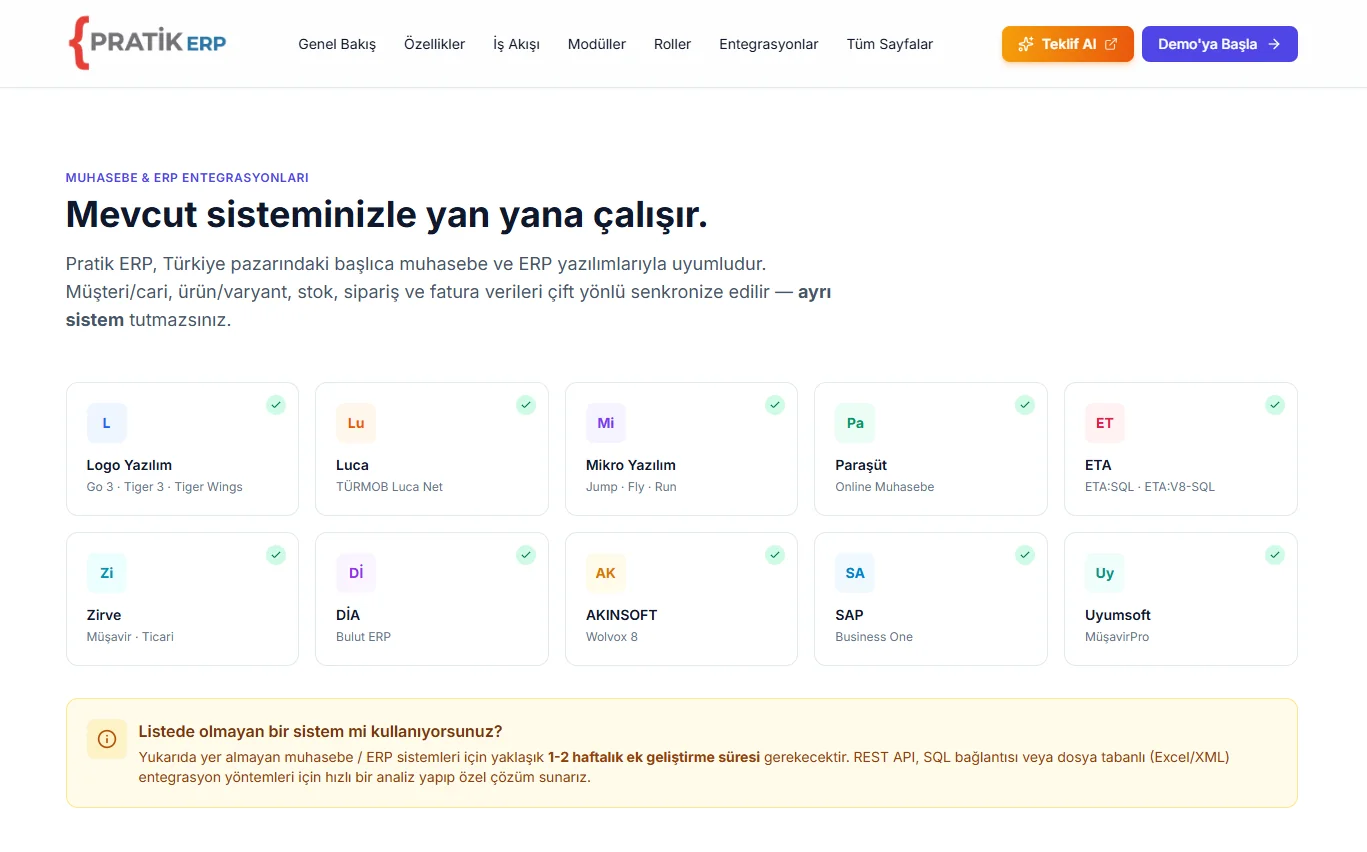
Two-way data sync with SAP, Mikro Muhasebe, and Logo Muhasebe protects your existing accounting investment, eliminates data loss during ERP migration, and prevents double data entry. Direct virtual POS integrations with all major Turkish banks (Is Bankasi, Garanti, Yapi Kredi, Akbank, Finansbank), 3D Secure payment acceptance, and end-of-day reconciliation are automated. e-Invoice, e-Archive, and e-Waybill infrastructure ships ready and GİB-compliant.
15 Business Days, Engineered in Turkey by Demircode
Pratik ERP is the SME-tailored evolution of the enterprise software Demircode has been producing since 2011. Account configuration, data migration, identity-aligned customization, key-user training, and go-live are completed within an average of 15 business days. After go-live, SLA-based 24/7 support, regular feature releases, and continuous adaptation to your evolving business processes are delivered by Demircode.
An Expanding Ecosystem with Demircode
Pratik ERP integrates with Demircodes other products — DCRM, DERP, DPAY, DGATE, IKYS — and you can extend it with custom software, web design, or mobile app services from the Demircode services team. As your business grows from SME to enterprise, you stay in the same vendor ecosystem with continuity and compounded efficiency.
How Does the Quote Process Work?
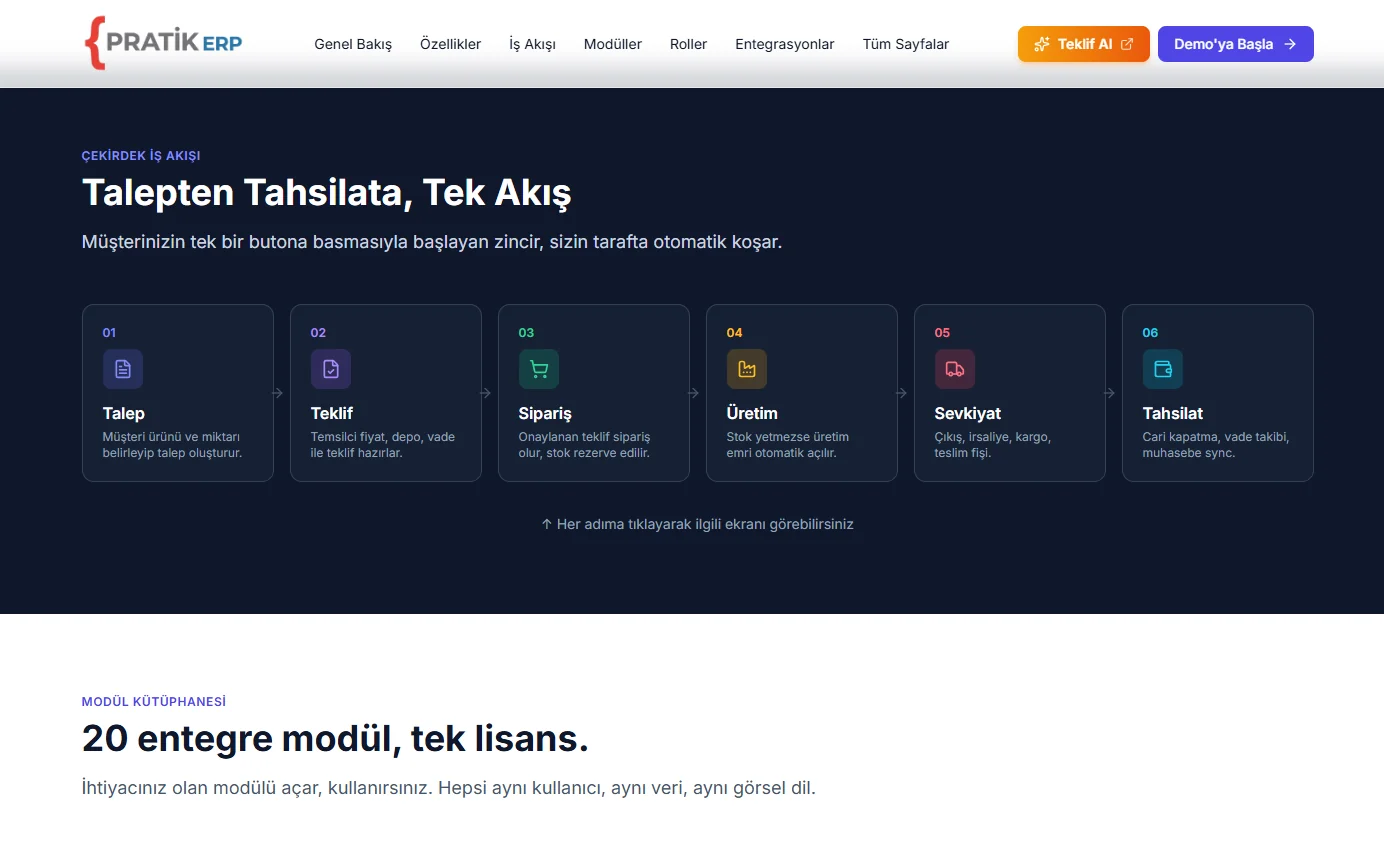
Request QuoteYour journey from inquiry to signed contract, step by step:
Fill the Form
Complete the online quote request form with your requirements.
Expert Review
Our experts analyse your request and prepare a tailored proposal.
Proposal Presentation
The prepared offer is presented to you via e-mail or a meeting.
Negotiation & Approval
Revisions are made if needed and the proposal is approved once agreed.
Contract & Kickoff
The contract is signed and the project or service is officially started.
Post-Purchase Process
Here is how your process unfolds step by step after purchase:
Discovery & Needs Analysis
3 Business DaysDepartment-by-department process mapping; existing systems (Excel, Mikro, Logo, legacy software) and data flows are identified. Module selection, user count, integration scope (SAP/Mikro/Logo/bank POS/e-Invoice), and customization requests are clarified; a fixed-price proposal is delivered.
Data Migration & System Configuration
4 Business DaysCustomer records, product catalog, open orders, invoice history, current account balances, and employee lists are migrated from existing systems to Pratik ERP. Company parameters, VAT rates, due-date rules, user roles, and approval flows are configured; corporate identity (logo, colors) is applied to the system.
Integration & System Testing
4 Business DaysSAP/Mikro/Logo accounting integration, Turkish bank virtual POS connections, e-Invoice/e-Archive special-integrator integration, SMS and email gateway configuration are completed. End-to-end customer-lifecycle scenarios (order → stock decrement → invoice → collection → accounting record) are tested in the sandbox; findings are corrected.
Key-User Training & Pilot
2 Business DaysModule-based training is delivered to key users (3-7 people: sales manager, inventory lead, accountant, IT). Sessions are video-recorded; module-by-module user manuals are delivered as PDFs. A one-day pilot operation is run: real daily transactions execute in parallel between test and live environments.
Go-Live & SLA Support
2 Business DaysPratik ERP launches in production; all users transition to live, legacy systems are archived. The first 90 days are a warranty period: all bugs are resolved at no charge, the live support line is open 24/7. An SLA-based annual support contract is signed; average 2-hour reply time, monthly feature updates, and GİB regulation adaptation are managed by Demircode.
Modules
Included Modules
Add-on Modules
Havale/EFT ile Ödeme
Teklif ile Süreç
FAQ
Pratik ERP is a modular ERP & CRM software that lets SMEs and mid-market companies run every operation from a single panel. It is suitable for manufacturing companies, e-commerce businesses, distribution/wholesale firms, consulting firms, finance-insurance agencies, and service companies. It is the ideal solution for companies not yet ready for complex enterprise ERP investments but unable to keep growing on Excel and seeking digital transformation.
Pratik ERP's recommended starter package contains four core modules: CRM, Sales-Marketing Automation, Inventory-Warehouse Management, and Finance-Smart Collections. Together they cover the foundation of daily operations from customer management to inventory, sales, and collections. If you manufacture, add Production Planning (BOM); if you work with dealers, add the B2B Dealer Portal; if you have a field sales team, add the Mobile App — immediately or within 6 months. The 'buy what you need, add as you grow' approach keeps the initial investment low.
Yes. Pratik ERP offers two-way API integration with Mikro Muhasebe, Logo Muhasebe, and SAP; current accounts, invoices, collections, and bank movements sync automatically. You avoid data loss during the migration and double data entry. Integrations for other packages (Netsis, Eta, Zirve, etc.) can be built on request. Your existing accounting investment is preserved.
Data migration from Excel, Mikro, Logo, legacy custom software, or other ERP systems is performed by the Demircode engineering team. Master data — customer records, product catalog, open orders, invoice history, current account balances, employee lists — is migrated to Pratik ERP within 1-3 business days, followed by validation through sample scenarios. Total migration time depends on data volume but is included in the 15-business-day delivery window.
Pratik ERP offers two separate native mobile apps: a 'field sales team' app (order taking, digital signatures, inventory checks, customer-visit forms) and a 'customer' app (current-account view, order history, invoice records, support tickets) for both iOS (App Store) and Android (Google Play). Both apps work offline; pending data syncs as soon as the network is back.
Pratik ERP provides role-based access control (RBAC); per-user department, module access, and record view/edit/delete rights are defined separately. A sales rep sees only their own customers, a manager sees the whole team's data, accounting sees only financial records. Approval flows (orders, expenses, leave) are auto-routed by permissions. Every user action is recorded in the audit log; data security is managed in line with SOC 2 standards.
Pratik ERP offers direct virtual POS integrations with Is Bankasi, Garanti BBVA, Yapi Kredi, Akbank, and Finansbank. 3D Secure, installment configuration, instant refund and cancellation operations, and end-of-day reconciliation reports run automatically. Other banks (TEB, Halkbank, Ziraat, Denizbank, etc.) can be added on customer request. All POS transactions run on PCI DSS-compliant infrastructure.
Yes. Pratik ERP integrates two-way with Turkish GİB special integrators (Logo, Mikro, Foriba, KolaySoft, Idea, etc.). e-Invoice, e-Archive Invoice, and e-Waybill are issued automatically and sent to GİB; incoming documents appear in the system inbox. For companies needing e-Ledger (journal + ledger), data is forwarded to the accounting side. VAT rate changes and exemption rules update automatically.
Pratik ERP is delivered by default as SaaS on Demircode cloud infrastructure (Turkey data center) — the server, backup, and security-update overhead is on the Demircode engineering team. Companies that require running the system on their own server (on-premise) due to data localization, regulation, or security policy can opt for an on-premise deployment, offered under a license + annual maintenance model. Hybrid (app in cloud, database on-prem) architecture is also supported.
After data migration and configuration, key users (3-7 people) receive module-based training. Training is delivered live (online or on-site) and recorded; module-by-module user manuals are shared as PDFs. The first week is close-monitoring: the Demircode support team answers questions same-day. In the second week, in-company rollout begins; all-employee training is completed by the key users. A refresher session is repeated every 6 months.
Pratik ERP pricing has five components: (1) one-time setup fee — based on module selection, data migration volume, and customization scope; (2) monthly usage fee — based on user count and active modules; (3) integration fee — for SAP/Mikro/Logo/bank POS or other selected integrations; (4) training fee (initial setup period + every-6-month refreshers); (5) support SLA fee (annual subscription). After a detailed analysis, a transparent fixed-price proposal is delivered — no surprise add-ons.
Yes. The standard package includes a 90-day warranty period after go-live — all bugs are resolved at no charge during this time. After that, an annual SLA-based support contract begins: 24/7 emergency response, average 2-hour reply time, monthly feature updates, automatic adaptation to GİB regulation changes, and adaptation to changes in your business processes. Demircode has been maintaining its software at the same standard since 2011.
Related Products


Related Services

Related Blog Posts