What You'll Learn from This Article
- A rank tracker records where your website ranks for chosen keywords across specific locations and devices, then stores that position history over time.
- Google Search Console reports averaged positions for free, while paid trackers add precise localized ranks, competitor data, and SERP feature monitoring.
- Setting location, language, and device correctly is essential because the same keyword can rank very differently for each market and each screen.
- Search visibility, position distribution, and estimated traffic turn raw ranks into business signals that guide where to focus your SEO effort.
- The right rank tracker combines accurate local tracking, flexible scheduling, competitor monitoring, and clean white-label reports at a scalable price.
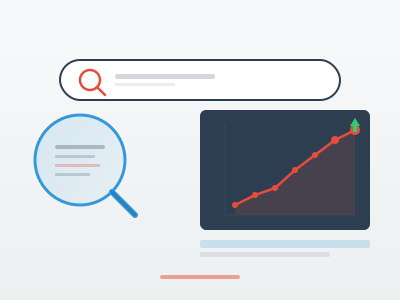
Quick answer: A rank tracker is a tool that automatically checks where your website appears in search results for a defined set of keywords, then records those positions over time. It runs simulated searches from specific locations and devices, captures the exact rank of your pages, and stores the history so you can see whether your visibility is rising or falling. Good rank trackers also monitor competitors, flag SERP features such as featured snippets, and estimate the organic traffic tied to each position. In 2026, reliable position tracking is the foundation of any measurable SEO program.
What Is a Rank Tracker and How Does SERP Position Tracking Work?
A rank tracker, sometimes called a SERP position checker, answers one deceptively simple question: for a given keyword, on which page and at which position does your website appear in the search results? Because the answer changes constantly and depends on where the searcher is located and which device they use, checking by hand is slow and unreliable. A dedicated tool solves this by sending automated queries to the search engine and recording the position of every URL that belongs to your domain.
The mechanics matter because accuracy depends on them. Modern trackers simulate a clean, personalization-free search from a chosen country, city, or postal code, on either a mobile or desktop crawler, so the reported rank reflects what a typical visitor would see rather than your own logged-in view. The tool then repeats this on a schedule and writes each result to a time-series database. The table below compares the main ways to track positions.
| Tracking Method | Update Frequency | Position Accuracy | Cost Level |
|---|---|---|---|
| Manual Google search | On demand | Low, skewed by personalization | Free |
| Google Search Console | Daily average | Medium, averaged over queries | Free |
| Browser SEO extension | On demand | Medium, single manual snapshot | Free or low |
| Standalone rank tracker | Daily or hourly | High, location and device specific | Low to mid |
| All-in-one SEO suite | Daily or weekly | High, plus SERP features | Mid to high |
| Local map-pack tracker | Daily | High for map and local packs | Low to mid |
| Enterprise tracking API | Real time or hourly | Very high, fully configurable | High |
How to Track Keyword Positions Over Time: Step by Step
Setting up position tracking is not just about pasting keywords into a tool. A repeatable process turns raw rank data into decisions. Follow these ten steps to build a tracking system that stays accurate as your site and the search results evolve.
Build your keyword list
Start with the terms that actually drive business value, not just high-volume vanity phrases. Pull queries from Google Search Console, your paid search reports, and real customer language, then prioritize keywords with clear commercial or informational intent. A focused list of one hundred meaningful terms beats a bloated list of thousands you will never act on.
Group keywords with tags
Assign tags or labels so related terms sit together, for example by product line, funnel stage, landing page, or language. Grouping lets you measure visibility for a whole topic cluster rather than isolated words, and it makes reporting far cleaner when you show progress for one service or region at a time.
Set location and language
Rankings vary by country, city, and even postal code, so configure the exact locations your customers search from. If you serve multiple markets, track each one separately and match the search language to the audience. For a business operating across Turkish, English, German, and Arabic markets, this is essential, because the same keyword ranks very differently in each locale.
Choose device: mobile or desktop
Mobile and desktop results often differ in order and in the SERP features shown, and Google indexes mobile-first. Decide which device reflects most of your traffic and track it as the primary view, then add the second device for keywords where the gap between them is wide. Ignoring mobile positions is a common blind spot.
Set tracking frequency
Daily updates suit competitive terms where positions move quickly, while weekly checks are usually enough for stable, low-volatility keywords. More frequent tracking costs more, so match the schedule to how fast each group actually changes. During a migration or major content push, temporarily raise the frequency to catch sudden drops.
Add competitor domains
Enter the domains of your main rivals so the tracker records their positions alongside yours for the same keywords. Relative movement is more informative than your own rank in isolation: gaining two spots while a competitor gains five still means you are losing ground. It also reveals which pages are overtaking you and which content gaps to close.
Establish a ranking baseline
Before you change anything, let the tracker run for a week or two to capture a stable starting point. This baseline is what every future result is measured against, so you can attribute gains and losses to specific actions rather than normal daily noise. Without it, you are only guessing whether your work moved the needle.
Monitor daily position changes
Set alerts for significant swings, such as a keyword dropping out of the top ten or a page suddenly losing several positions. Daily monitoring is your early warning system for algorithm updates, technical errors, and competitor moves. The goal is not to chase every one-position wobble but to catch the meaningful shifts in time to respond.
Analyze ranking trends
Zoom out from single-day readings to weekly and monthly trend lines, because the direction over time tells the real story. Look at whether a whole cluster is trending up, whether seasonal patterns repeat, and how your visibility curve responds to each content or technical change. Trends separate durable progress from short-lived spikes.
Report and act on data
Turn the numbers into decisions and share them in a format stakeholders understand. Highlight which keywords improved, which pages need attention, and what you plan to do next. The best rank trackers export scheduled reports automatically, so your team acts on the data instead of assembling spreadsheets by hand.
Key Metrics Every Rank Tracker Reports
Position numbers are only the surface. The metrics below translate raw ranks into visibility and business impact, and understanding them helps you read any tracking dashboard with confidence.
Average keyword position
This is the mean rank across all tracked keywords for a given date, and it gives you a single headline number for overall performance. Treat it as a directional signal rather than an exact truth, because one keyword jumping from position fifty to five can move the average without reflecting broad progress. The average per tag group is usually more meaningful than one site-wide figure.
Search visibility score
Visibility is a weighted percentage that estimates how much of the total possible clicks your keyword set captures, giving higher weight to top positions and higher-volume terms. It compresses hundreds of rankings into one trend line you can watch daily. A rising score means your presence is expanding even when individual positions bounce around.
Position distribution buckets
Distribution groups your keywords into ranges such as positions one to three, four to ten, eleven to twenty, and beyond. This view shows where your opportunities sit: a cluster stuck on page two is often the fastest path to more traffic, because moving those terms onto page one delivers an outsized click increase compared with improvements deeper down.
Estimated organic traffic
By combining each position with typical click-through rates and search volume, trackers estimate the organic visits your rankings should generate. It is a modeled figure, not a measured one, so pair it with real analytics data. Even so, it is valuable for prioritization, pointing you toward the keywords where a small rank gain produces the largest traffic reward.
SERP feature presence
Modern results pages include featured snippets, People Also Ask boxes, image packs, local packs, and more, and these features push classic blue links down. A good tracker flags which features appear for each keyword and whether you own them. Winning a snippet can matter more than a slightly higher standard position, so tracking feature ownership is now essential.
How to Choose the Right Rank Tracker: A Checklist
Not every tool fits every business, and the right choice depends on your markets, your scale, and how you report. Use this checklist to evaluate any rank tracker before you commit.
- Accurate localized tracking: the tool must return positions for the exact countries, cities, and postal codes your customers search from, in the correct language, so the data reflects real local demand.
- Flexible update scheduling: look for the ability to set daily, hourly, or on-demand refreshes per keyword group, so you pay for speed only where volatile terms actually need it.
- Competitor rank monitoring: the tracker should record several rival domains alongside yours for every keyword, turning isolated ranks into meaningful relative benchmarks.
- Mobile and SERP-feature data: mobile-first positions and clear reporting on snippets, local packs, and other features are non-negotiable in 2026, not optional extras.
- White-label reporting exports: scheduled, branded reports in PDF and spreadsheet formats save hours and let agencies and internal teams share results cleanly with stakeholders.
- Scalable per-keyword pricing: confirm that costs grow predictably as you add keywords and locations, with no steep penalties that punish you for expanding coverage later.
Free vs. Paid Rank Trackers: Making the Right Investment in 2026
Free tools have a real place. Google Search Console is the most honest free source of position data because it reports actual averaged rankings from real impressions, and a browser extension is fine for a quick manual check. The limits appear fast, though: Search Console averages positions and hides the exact daily rank per location and device, while manual checks cannot scale, track competitors, or store clean history. For a hobby site or a single landing page, free coverage may be all you need.
Paid trackers earn their cost the moment tracking becomes a business function rather than a curiosity. Reliable localized positions, daily history, competitor benchmarks, SERP-feature monitoring, and automated white-label reports shorten the loop between insight and action, and that speed usually pays for itself in recovered or captured traffic. The smart approach in 2026 is hybrid: lean on Search Console for ground-truth data and volume, and add a paid tracker for the precise, scheduled, competitive intelligence that free tools structurally cannot provide.
Why Demircode
Demircode has delivered more than one hundred software and web projects since 2011, and search visibility sits at the center of how we build and grow digital products.
- Measurable SEO strategy: we tie every tracked keyword to a clear business goal, so rankings translate into leads and revenue rather than vanity charts.
- Multilingual market coverage: we track and optimize across Turkish, English, German, and Arabic results, matching each market with native-quality content and correct localization.
- Technical SEO foundations: our developers fix the crawlability, speed, and structure issues that quietly cap your rankings before content work can pay off.
- Custom tracking dashboards: we build reporting that blends rank data with real analytics, so stakeholders see one clear picture of visibility and traffic.
- Competitor and SERP intelligence: we monitor rivals and SERP features continuously and turn that intelligence into a concrete content and technical roadmap.
- Local team advantage: you work with a dedicated local team that communicates clearly, follows privacy-compliant processes, and responds fast whenever you need support.
Whether you need a full ranking program or a targeted fix, our Search Engine Optimization (SEO) and Web Development teams work together so that better rankings are backed by a faster, cleaner, and more crawlable website.
For more on climbing the results, read our related guides: How to Rank on Google First Page and What Is SEO Optimization.
Frequently asked questions
How often should I check keyword rankings?
For most businesses, daily tracking on competitive terms and weekly tracking on stable ones is the right balance. You rarely need to open the dashboard every day, but the tool should collect data daily so the history is complete when you do review it, and you can raise the frequency temporarily during migrations or major launches.
Why do my rankings differ from what I see in Google?
The results you see are personalized by your location, search history, logged-in account, and device, so they are not neutral. A rank tracker deliberately strips that personalization and queries from a fixed location and device, which produces the more objective position that a typical new visitor would encounter, and that is the number to trust.
Can I track local and mobile rankings separately?
Yes, and you should. Quality trackers let you set a specific city or postal code and choose a mobile or desktop crawler for each keyword or group. Local and mobile results frequently differ from national desktop results, especially for service businesses, so tracking them separately gives you a far more accurate picture of what nearby customers actually see.
Are free rank trackers accurate enough for business use?
Google Search Console is accurate for averaged positions and is genuinely useful, but it hides exact daily ranks by location and device and does not track competitors, while free browser extensions give only manual, one-off snapshots. For a serious business that needs localized history, competitor benchmarks, and scheduled reports, a paid tracker is worth the investment.
How many keywords should a small business track?
Most small businesses do well with fifty to two hundred carefully chosen keywords that map to their core services and locations. Focus on terms with clear commercial intent and real local demand rather than chasing a huge list, because a tight, well-organized set is cheaper to track, easier to analyze, and far more likely to drive real decisions.
Conclusion
A rank tracker turns the invisible movement of search results into clear, measurable data you can act on: which keywords are rising, where competitors are gaining, and which pages deserve your next hour of work. Choose a tool that delivers accurate localized positions, mobile and SERP-feature data, competitor monitoring, and clean reports, then pair it with a disciplined process of baselines, alerts, and trend analysis. If you want expert help building that program end to end, our Search Engine Optimization (SEO) team is ready to make your rankings work for your business.
Related Products

Related Services