What You'll Learn from This Article
- Google is one company running many connected products, from Search, Ads and YouTube to Android, Chrome, Maps, Workspace, Cloud and the Gemini AI models.
- Advertising sold across search results, video and partner sites remains the dominant revenue engine, while subscriptions and cloud contracts form a growing second pillar.
- The company was incorporated in 1998 out of doctoral research at Stanford University and has operated since 2015 as the principal subsidiary of the holding company Alphabet.
- A business should claim its Business Profile and connect Search Console and Analytics under company owned accounts before spending anything on paid advertising.
- The ecosystem gives small teams enormous leverage, so the real discipline is using it deliberately while keeping the domain, the customer data and the core product independent.
Quick answer: Google is an American technology company that was incorporated in 1998 and has operated since 2015 as the principal subsidiary of the holding company Alphabet. It is known for search, yet the majority of what it earns comes from advertising sold across its own surfaces and across partner sites. Around that engine sits a connected family of products including Android, Chrome, YouTube, Maps, Workspace, Google Cloud and the Gemini AI models, all tied together by a single account system. For a business, Google is therefore less a website to visit and more a bundle of free tools, paid channels and rented infrastructure that shapes how customers find you and how your team works every day.
What Google Is in 2026: One Company, Many Products and an Ecosystem Map
Ask most people what Google is and the answer will be a search box. That answer was reasonably accurate around the turn of the millennium and is badly incomplete in 2026. The same organization now develops the operating system running on a very large share of the phones in circulation, the browser that many desktops and handsets open by default, the video platform where a whole generation looks things up, the mapping service that decides whether a customer can actually find your premises, the mail and document suite that thousands of companies run their internal work on, and a cloud division that rents out the same class of infrastructure those products were built on.
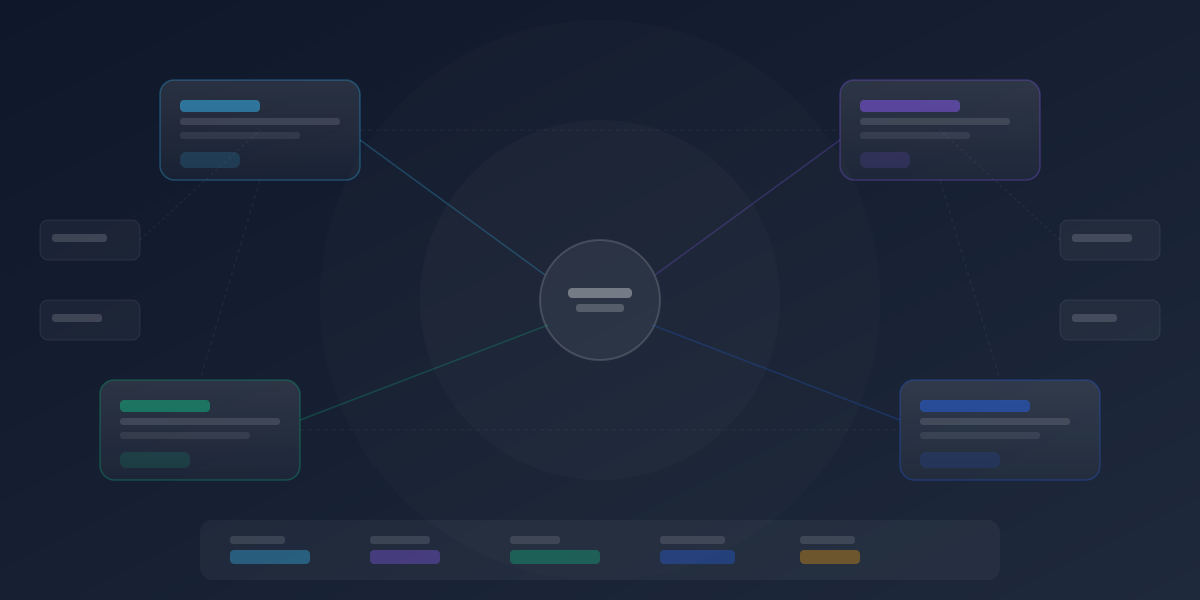
None of these pieces stands alone, and that is the entire point. Android and Chrome keep search one tap away. Search and video gather the attention that advertisers pay to reach. Advertising income funds research and data centers that no subscription business of comparable size could finance, and the AI capability produced by that research is then sold back to enterprises through the cloud division. The map below sets out the main components and the specific job each one performs inside that machine, so the sections that follow can look at each in turn.
| Product or service | What it does in one line | Main audience (consumer or business) | Role in the business model |
|---|---|---|---|
| Google Search | Answers questions and routes people onward to websites, apps, shops and nearby locations | Consumer facing, with heavy commercial impact | Generates the attention and the advertising inventory that fund most of the group |
| Google Ads and AdSense | Sells placement to advertisers and pays site owners for the space that gets filled | Business: advertisers on one side, publishers on the other | The direct revenue engine and the auction where demand meets supply |
| Android | Provides the mobile operating system that device makers license and ship on their hardware | Consumer, plus a very large developer base | Distribution: keeps the services and the account within reach on mobile |
| Chrome | Offers a free browser for desktop and mobile built on an open source engine | Consumer, plus web developers | Secures a dependable entry point to the web and to search |
| YouTube | Hosts, recommends and monetizes video for viewers, creators and brands | Consumer, plus creators and advertisers | A second large advertising surface, supplemented by paid subscription tiers |
| Google Maps and Business Profile | Supplies maps, navigation and the free listing that represents a physical location | Consumer, plus local and service businesses | The local discovery layer and a channel for location based advertising |
| Google Workspace | Runs mail, storage, documents and meetings for teams under central administration | Business | Recurring per seat subscription income that does not depend on advertising |
| Google Cloud and Gemini AI | Rents hosting, data platforms and AI models to companies and developers | Business and technical teams | The enterprise pillar and the commercial route to market for AI capability |
Inside the Google Product Ecosystem: What Each Service Actually Does
Each product below solves a different problem for a different audience, yet all of them share accounts, data formats and, increasingly, the same underlying models. Understanding what each one is genuinely for makes it far easier to decide which parts of the ecosystem your business needs now, which parts can wait until you are larger, and which parts you can leave alone entirely without losing anything.
Search and AI Overviews: the discovery layer
Search is the discovery layer for the open web. A person asks a question by typing or speaking, and the service returns links, direct answers, local results, product listings and, more and more often, an AI written summary sitting above everything else. For a business this is the moment when intent becomes traffic, which is why so much marketing effort is aimed squarely at it. What happens behind that box, meaning how pages are discovered, stored and put into order, is a separate subject with its own logic, and our companion guide on What Is a Search Engine covers that mechanism properly rather than leaving it as a black box.
Google Ads and AdSense: the two sides of the ad marketplace
These two products are the buying counter and the selling counter of one marketplace. Google Ads is where an advertiser sets a budget, chooses keywords, audiences, devices or locations and bids for placement beside results, on maps, inside video or across partner inventory. AdSense is the opposite side, where a publisher or site owner offers space on their own pages and receives a share of what advertisers pay to occupy it. The company sits in the middle, matches both sides in an auction that resolves in milliseconds, and retains a portion of every transaction that clears.
YouTube: video platform, creator economy and ad inventory
YouTube began as a place to upload clips and became a full media economy. Creators publish, viewers watch and subscribe, advertising runs before, during and around the content, and a share of that money flows back to the people who produced it. For a business the platform performs three jobs simultaneously. It is an owned marketing channel where product explanations, tutorials and case studies keep earning views for years. It is a paid advertising surface with detailed targeting. And it is a destination for questions in its own right, because a large share of how to queries now start there rather than in a text field.
Android: the mobile operating system that carries the ecosystem
Android is the operating system behind a very large proportion of the phones and tablets in daily use. Google maintains the core, publishes much of it as open source, and licenses the branded services layer to manufacturers who want the familiar store and default applications on their devices. Commercially it matters less as something a customer purchases and far more as distribution. It keeps search, maps, video and the account system within reach of an enormous installed base, and it gives software teams a single large market to publish into, with billing, permissions and updates handled centrally.
Chrome: the browser as entry point to the web
Chrome is a free browser available on every major desktop and mobile platform, built on an open source engine that several other browser projects also depend on. Nobody pays for it, so its value is strategic rather than direct. It guarantees a stable entry point to the web, keeps sign in and synchronization attached to one account across devices, and gives engineers a fast route for shipping new web standards, performance improvements and privacy controls. For anyone who builds software it also supplies the developer tooling used to inspect, debug and profile modern web applications.
Google Maps and Business Profile: local presence for physical businesses
Maps handles navigation, transit, traffic and place data, while Business Profile is the free record a company claims in order to control how it appears on that map and inside local results. Between them they determine whether a nearby customer sees the correct address, opening hours, phone number, photographs and reviews at the exact moment of need. For restaurants, clinics, workshops, showrooms, dealerships and any service tied to a catchment area, an accurate and actively maintained profile is frequently worth more than a sizeable advertising budget spent elsewhere.
Google Workspace: Gmail, Drive, Docs and Meet for teams
Workspace is the paid business edition of the tools most people already know from personal use. It bundles mail on your own domain, cloud storage, collaborative documents and spreadsheets, shared calendars, video meetings and an administration console into a per user subscription. The administration layer is the part that carries the commercial weight: central account creation and removal, device and access policies, retention rules, shared drives owned by the organization rather than by an individual employee, and audit logs. This is one of the clearest cases where the company sells software directly instead of selling attention.
Google Cloud: hosting, data and enterprise infrastructure
Google Cloud rents out the same class of infrastructure that was built to run the consumer products: virtual machines and containers, managed databases, object storage, networking, analytics warehouses, security tooling and machine learning platforms. Customers pay for what they consume rather than buying, housing and refreshing servers of their own. This division is the second commercial pillar of the group and the reason it competes hard for long term enterprise agreements, where one signed contract can run for years and pull support, data services and AI workloads along behind it.
Gemini: AI models woven through Search, Workspace and Cloud
Gemini is the family name for the current generation of Google AI models, and the important detail is that it is not simply a standalone chat product. The same model family writes the summaries that appear above search results, drafts and condenses text inside mail and documents, powers assistance features on Android devices, and is sold to developers through cloud APIs so they can embed it into their own systems. AI has quietly become a layer running underneath the whole ecosystem rather than one more item sitting beside the others on a product list.
Analytics, Search Console and Merchant Center: the free business toolkit
Alongside the paid products sits a set of free tools aimed directly at businesses. Analytics reports how visitors reach your site, what they do once they arrive, and which paths end in a sale or an inquiry. Search Console shows which queries surface your pages, which addresses have technical faults, and how the site is being interpreted. Merchant Center feeds product data, prices and stock levels into shopping surfaces for retailers. None of them costs anything to use, and together they form the measurement layer that makes every other digital investment accountable.
The Company Behind the Products: Origins, Structure and Revenue Sources
The product list describes what Google does day to day, but the shape of the company explains why it behaves the way it does. A short history and a clear view of where the money actually comes from make the strategy far easier to read, and they also explain why some services stay free for decades while others arrive with a monthly invoice attached.
1998 origins: from a Stanford research project to an incorporated company
The idea began as doctoral research at Stanford University by Larry Page and Sergey Brin, who investigated ranking web pages by the links pointing toward them instead of by counting keywords printed on the page. The project rapidly outgrew a university network, and the company was formally incorporated in 1998, operating at first from rented space rather than a campus of its own. Within a handful of years the search engine had become the default starting point for the web, and the commercial model that still funds everything arrived shortly afterwards.
Advertising: the dominant revenue engine across Search and YouTube
Advertising continues to supply the clear majority of revenue. The model is easy to describe and extremely hard to copy: assemble enormous attention with products that cost the public nothing, then sell precisely targeted placement beside that attention, charging mainly when someone clicks or watches. Search advertising reaches people at the moment of intent, video advertising reaches them during entertainment and research, and the partner network extends the same auction across third party sites and applications. Every other ambition the company holds rests on that financial base.
Subscriptions: Workspace seats, Google One storage and YouTube plans
Subscriptions form a smaller but steadily growing second stream. Companies pay monthly for Workspace seats, individuals pay for additional storage and AI features through Google One, and viewers pay for advertisement free video and music tiers. Recurring income is attractive precisely because it is predictable and much less exposed to the swings of advertising demand during a downturn. It also shifts internal incentives, because paying customers reward reliability, support quality and thoughtful software far more than they reward raw reach.
Google Cloud and enterprise contracts as the second pillar
Cloud is the deliberate answer to concentration risk inside the group itself. Selling infrastructure, data platforms and AI capacity to enterprises brings revenue from an entirely different buyer, on multi year contracts, through a sales motion that resembles traditional business software far more than consumer products do. It also gives the research effort a direct commercial outlet, because the same models offered free to the public can be billed by usage to companies building their own applications on top of them.
Alphabet holding structure and other bets
Since 2015 Google has operated as the principal subsidiary of Alphabet, a holding company that keeps the profitable core separate from smaller experimental ventures, and the full ownership and shareholding picture is set out in our companion article on Who Owns Google.
Google Setup Checklist for a Business in 2026
Working well with Google does not mean adopting every product it publishes. It means setting up a small number of accounts correctly, under company control, before any money goes into advertising. The six steps below cover the foundation that nearly every business needs, arranged in the order that usually makes practical sense.
- Claim and verify your Google Business Profile: Confirm ownership of the listing, then check the name, address, phone number, categories, opening hours, service area and photographs, because for a local customer this record very often arrives before your website does.
- Connect Search Console and Analytics to your website: Both are free and take minutes to install, and without them you are guessing about which pages attract visitors, which queries you already appear for, and which technical faults are quietly holding the site back.
- Own accounts with a company identity, not a personal Gmail: Create properties, profiles and campaigns under an account the business itself controls, so access survives staff departures, agency changes and disputes, then grant colleagues named permissions instead of circulating one shared password.
- Decide whether Google Ads fits your funnel and margins: Paid search rewards businesses with a clear conversion path and enough margin per sale to absorb the cost of a click, so model the numbers and the follow up process before launching rather than after the budget has already gone.
- Review consent, privacy and data retention settings: Configure cookie consent, retention periods and regional processing options so your measurement setup matches GDPR, KVKK and any sector specific rules that apply to you, then record those decisions somewhere an auditor can actually find them.
- Keep an export and backup path for mail, files and data: Schedule regular exports of mailboxes, documents, contacts and reporting history into storage you control, so a suspended account or a billing mistake never escalates into a business continuity failure.
Building on Google Without Depending on It: Ecosystem Leverage vs Concentration Risk
The genuine advantage of this ecosystem is leverage. A team of five can reach a national audience through search and video, run mail and documents for a modest monthly fee, publish an application into a global store, measure every campaign with free tools, and rent computing power that once demanded a server room and a full time administrator. Very few organizations could assemble that capability alone, and refusing it on principle mostly hands an advantage to competitors who accept it without hesitation. The sensible position is to take the leverage deliberately, product by product, based on what the business actually needs rather than on habit or on what a conference speaker recommended.
The risk appears when leverage slides quietly into dependency. If a single search channel is your only source of customers, your only mailbox lives in one suite, your customer list sits inside one advertising account and your whole application runs on one provider, then a ranking shift, a policy update, a price revision or a suspended account stops being an inconvenience and becomes an existential event. The countermeasures are unglamorous and effective: own your domain and your website instead of renting a presence on a platform you do not control, build a direct email list, keep scheduled exports of anything critical, spread demand across search, referral, social, email and offline sources, and write software with reasonable portability so infrastructure can move when commercial terms change. Treat the ecosystem as a powerful distribution and infrastructure layer, and keep the customer relationship, the data and the core product firmly in your own hands.
Why Demircode
Demircode has been building websites, custom platforms and integrations since 2011, across more than one hundred delivered projects. That experience shapes how we connect a client business to the Google ecosystem: deliberately, measurably, and without creating dependencies that turn out to be painful and expensive to unwind two years later.
- Search ready engineering: We build sites with clean semantic markup, fast loading, sensible information architecture and correct structured data, so the technical groundwork for visibility exists from the first release instead of being retrofitted under pressure.
- Measurement configured properly: Analytics, Search Console, conversion tracking and consent handling are part of delivery, not an afterthought discovered months later when traffic arrives and nobody can explain where it came from.
- Custom software and integrations: We connect websites, admin panels and internal systems to the APIs that matter, from maps and mail to cloud services and AI models, always through accounts and credentials that belong to you.
- Portable architecture: Applications are written so that hosting, storage and third party services can be replaced without a rewrite, which protects you when pricing, quotas or platform policies change without notice.
- Privacy and compliance by design: Retention rules, consent flows, access control and encryption are designed into the system from the beginning rather than patched on in a hurry before an audit or a customer questionnaire.
- A dedicated local team: You get clear communication, privacy-compliant processes and fast support from people who stay close to your project instead of routing you through an anonymous ticket queue.
Whether you need a first company website, a rebuild that finally performs, or a platform shaped around the way your business genuinely operates, our Web Development and Custom Software Development teams can carry the work from plan to live product.
For related background, read our guides Who Owns Google and What Is a Search Engine.
Frequently asked questions
What is the difference between Google and Alphabet?
Alphabet is the parent holding company created in 2015, and Google is the subsidiary that contains the products almost everyone uses, including Search, Ads, Android, Chrome, YouTube, Maps, Workspace and Cloud. The separation allows the profitable core to run under one management team while smaller experimental ventures are funded and reported on their own. In ordinary conversation people say Google, while stock listings and financial reporting refer to Alphabet.
How does Google make money when most of its products are free to use?
Free products create audience, and audience is what advertisers buy. Search, Maps, Chrome, Android and YouTube cost the public nothing, yet together they gather enormous attention that can be sold as precisely targeted advertising placement. On top of that the company charges directly for Workspace seats, extra storage, subscription video tiers and cloud infrastructure, so a growing share of revenue now comes from customers who settle an invoice rather than click an advertisement.
Which Google tools should a small business set up first?
Begin with three that cost nothing. Claim and verify the Business Profile so nearby customers find accurate details. Connect Search Console so you can see which queries already reach your pages and which technical problems need fixing. Add Analytics so you know where visitors come from and what they do next. Only once those three produce reliable data does paid advertising make sense, because you will then be able to judge honestly whether it worked.
Is Gemini replacing Google Search, and what does that mean for websites?
AI is being layered into search rather than replacing it, which changes the shape of the results page more than it changes the existence of the product. Summaries answer straightforward factual questions on the spot, so thin informational pages can expect fewer clicks, while pages offering depth, original expertise, pricing, comparison or a clear next step retain their value because people still click through in order to act. The practical response is to publish content that earns a visit instead of content that repeats what a summary already states.
Does using more Google products improve my search rankings?
No. Buying advertising, subscribing to Workspace or installing Analytics does not grant preferential treatment in organic results, and the company has stated this consistently for years. Those tools help indirectly by revealing problems and opportunities you would otherwise miss, and an accurate Business Profile does genuinely affect local visibility, but paying for one product never buys position in another. Results still depend on relevance, quality, technical health and the trust a site has earned over time.
Conclusion
Google is best understood as a company that gives away remarkably useful products in order to gather attention, sells that attention to advertisers, and reinvests the proceeds into mobile, cloud and AI infrastructure that increasingly earns money on its own terms. For a business the practical question is never whether to use it, but which parts to adopt, who owns the accounts, and how to keep customers, data and core systems independent enough that a policy change stays an annoyance instead of becoming a crisis. If you want a website and a software foundation built with that balance in mind, our Web Development team can build it with you.
Related Products
Related Services