What You'll Learn from This Article
- You will learn what a DDoS attack is, how it differs from classic DoS, and how it works.
- You will understand the differences between volumetric, protocol and application layer attacks.
- You will be able to apply core protection layers like CDN, WAF, rate limiting and geo-blocking.
- You will learn 2026 DDoS attack trends and average attack sizes.
- You will understand what to do during an attack and how to conduct a post-mortem analysis afterwards.
Quick answer: DDoS (Distributed Denial of Service) is a cyber attack that overwhelms a website or online service with artificial traffic from thousands of distributed sources, making it inaccessible. As of 2026, the average DDoS attack reaches 1 Tbps per second and can take down unprotected servers within minutes.
What Is DDoS?
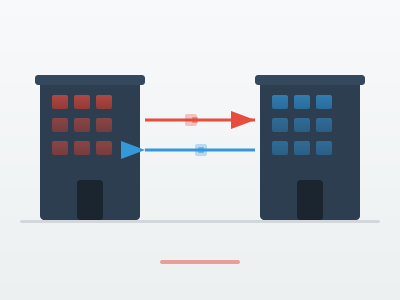
DDoS is the distributed version of the classic DoS (Denial of Service) attack. The attacker uses thousands or even millions of compromised devices around the world (typically a botnet of malware-infected IoT devices and servers) to send simultaneous requests to a target. When the target servers bandwidth, CPU or memory capacity is exhausted, legitimate users can no longer reach the site.
The first major DDoS attacks targeted banks and news sites in the early 2000s. By 2026, DDoS has become one of the most common cyber attack types, often launched for ransom (Ransom DDoS) or to take competitors offline.
DDoS Attack Types
1. Volumetric Attacks
Aim to fill the targets bandwidth. UDP Flood, ICMP Flood and DNS Amplification fall into this category, generating gigabit or terabit per second traffic.
2. Protocol Attacks
Target server resources or intermediary network devices (firewalls, load balancers). SYN Flood, Ping of Death and Smurf Attack are in this category. They exhaust the connection table rather than bandwidth, blocking new connections.
3. Application Layer Attacks (Layer 7)
Attacks that target application protocols such as HTTP/HTTPS. HTTP Flood, Slowloris and fake form submissions belong here. They can exhaust a server even with low traffic, because every request triggers backend resources.
The Scale of DDoS Attacks in 2026
- According to Cloudflare and Akamai reports, the average attack size reached 1 Tbps in 2026.
- The largest attacks peak above 5-6 Tbps.
- IoT botnets (smart cameras, routers, smart home devices) form the largest attack sources.
- Most attacks are now at Layer 7, because they are harder to detect.
- Ransom DDoS makes up about 15% of recorded attacks in 2026.
How to Protect Against DDoS Attacks?
1. Use CDN and DDoS Protection
Services like Cloudflare, Akamai, AWS Shield and Azure DDoS Protection filter traffic at a global scale and prevent malicious requests from reaching your servers. A site behind a CDN automatically deflects most volumetric attacks.
2. Web Application Firewall (WAF)
WAF is a critical defense layer against Layer 7 attacks. It blocks threats like SQL Injection and XSS while filtering anomalous HTTP requests. Modern WAFs offer AI-driven behavior analysis.
3. Rate Limiting
Limit the number of requests from a specific IP or user. For example, automatically block IPs sending more than 30 requests per second. This simple measure stops many low-level attacks.
4. Geo-Blocking
If you only serve users from specific countries, consider blocking traffic from others. Most DDoS attacks come from various geographies.
5. Network Capacity and Redundancy
Host your servers on high-capacity networks. Using multiple data centers (multi-region) lets you reroute traffic when one center is under attack.
6. Real-Time Monitoring and Alerts
A SIEM or monitoring solution that watches traffic anomalies in real time helps detect attacks early, increasing the success rate of any response.
7. DNS Protection
DNS is a primary target in many DDoS attacks. Use DDoS-protected DNS providers like Cloudflare DNS or Google DNS. If you run your own DNS server, enable response rate limiting (RRL).
What to Do During an Attack
- 1. Call your hosting provider: Professional hosts react quickly when an attack is detected.
- 2. Analyze the traffic: Which IPs, countries and protocols is the attack coming from? Use netstat, Wireshark or your CDN dashboard.
- 3. Tighten CDN mode: Enable I am under attack mode in services like Cloudflare to challenge every visitor with JavaScript.
- 4. Report the attack: Notify CERT or local cybersecurity authorities. Reporting botnet sources to ISPs is also important.
- 5. Post-mortem analysis: After the attack, review logs, close any vulnerabilities and reinforce protection layers.
Frequently Asked Questions
Are DDoS attacks legal?
No. Launching a DDoS attack or helping someone launch one is a crime in most countries. In Turkey, it is punished under Article 244 of the Turkish Penal Code and Law 5651.
Is DDoS protection paid?
Basic protection layers like Cloudflare and AWS Shield Standard are free. However, enterprise-grade protection against large-scale attacks requires paid plans such as Cloudflare Pro, Akamai Prolexic or AWS Shield Advanced.
Do small blogs need DDoS protection?
Yes. DDoS attacks target not only large companies but also small blogs and e-commerce sites. Attackers often select random targets with automated tools. Even a free CDN layer provides significant protection.
Does a DDoS attack steal data?
No. A DDoS attack is not aimed at stealing data; its goal is to make the service unavailable. However, DDoS is sometimes used as a smokescreen for another attack (such as SQL Injection or authentication bypass), so always analyze logs during an attack.
How do I know if my server is under a DDoS attack?
Abnormally high traffic, far more 5xx errors than usual, connection timeouts, sudden CPU/RAM spikes, and repeated request patterns from the same IPs are signs of DDoS. Modern CDN dashboards report attacks automatically.
Why Choose Demircode for Hosting and Maintenance?
At Demircode, our hosting and maintenance packages are designed to protect your websites against DDoS, ransomware and other cyber threats. With over 100 projects managed since 2011, we configure custom protection layers tailored to your needs.
- CDN integration: Professional setup and optimization of Cloudflare and similar services.
- WAF and rate limiting: Application-level protection against Layer 7 attacks.
- 24/7 monitoring: Anomalous traffic patterns are detected instantly.
- Regular backups: Fast recovery after a potential attack.
- Local team advantage: Direct communication, GDPR-compliant process, fast support.
To protect your website against DDoS attacks and keep it always reachable, explore our Domain and Hosting service and our Maintenance and Update service. In an emergency, our team is ready to step in.
Conclusion
DDoS attacks are one of the most common cyber threats anyone with digital assets needs to understand. As attack sizes continue to grow in 2026, the right combination of CDN, WAF and monitoring layers can neutralize the vast majority of them. Building a DDoS protection strategy is a decision that should be made before, not after, an attack happens.
Related Products
Related Services